
Meet The Spooniverse, Where Patients Learn About The Diseases Their Doctors Didn't Study In Medical School.
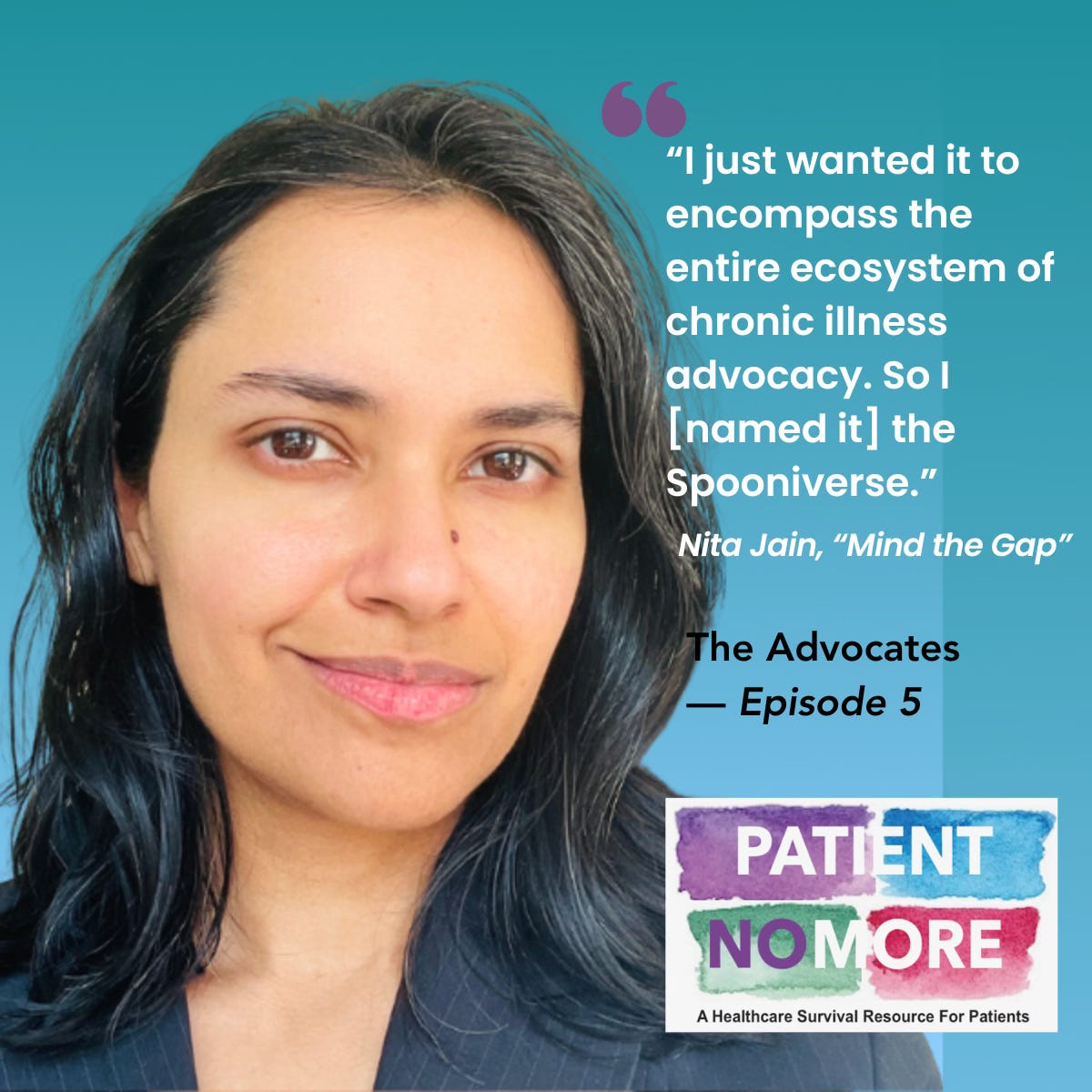
The Advocates. Episode 5. Nita Jain of Mind The Gap & Timeless Bioscience

There is a hidden world with its own language that no one wants to join yet millions of us are members. And the password is “spoonie.”
About 75% of Americans have at least one chronic illness, many of which are common and easy to identify. But millions of us have uncommon and complex medical conditions that can be difficult to diagnose and are severely understudied. Often these conditions deplete daily energy and are invisible to the casual observer.
Between 15 and 50 million Americans have one or more type of Autoimmune diseases. Approximately 10 to 40 million of us have dysautonomia, including the 1-3 million with POTS, and about two-thirds of Long COVID patients. Add in almost 10 million fibromyalgia patients, 1 million ME/CFS patients, and the 11% of women with endometriosis, just to name a few. The truth is that researchers aren’t certain exactly how many people are affected because no one fully understands the mechanisms involved in these complex diseases.
Medical science acknowledges there are major gaps in what we know about all of them.
Here’s the problem: our healthcare is organized in singular specialties by body function and organs. Cardiologists focus on our hearts and blood pressure. Neurologists deal with our nervous systems. Gastroenterologists focus on our digestive health, involving our stomachs and colon. However, most of these complex conditions affect multiple body systems with symptoms that cross boundaries.
As Nita Jain says at 00:08:57, “…it’s not unusual for your circulatory system, your nervous system, your gastrointestinal, circulatory, lymphatic, musculoskeletal, rheumatological effects for all of that to be affected at the same time.”
The Spooniverse is a clearinghouse for information for all of these complex chronic illnesses. It was created by a brilliant young woman in her spare time, when she wasn’t running the biotech startup she founded and the Substack she authors.
I spoke with Nita Jain, who built The Spooniverse so she could understand her own multiple complex chronic illnesses. And then decided to share it with the rest of us for free. You can listen to our interview, read the transcript and click on the links for more information, or read along to the interview. Don’t forget to subscribe to Mind The Gap and Patient No More.
TRANSCRIPT
[00:00:00] Helene: Nita Jain has lived with complex chronic illness for most of her life, and these experiences have informed everything she’s built. She created The Spooniverse, a reference platform for patients with ME/CFS, Long COVID. EDS, POTS, MCAS, and fibromyalgia, that includes a PubMed verified treatment database, Biomarker Explorer and Resource Directory.
[00:00:26] Nita founded Timeless Biosciences, a biotech startup focused on microbiome targeted therapeutics for patients with cancer. She also writes Mind the Gap on Substack, which is how we met, to help readers navigate the gaps in our healthcare system. We’re very excited to welcome Nita Jain today.
[00:00:53] Nita Jain, I’m so happy to see you here. Thank you.
[00:00:56] Nita: Thanks for having me.
[00:00:58] Helene: You wear a lot of hats, especially for a member of the Spooniverse, and I’m a member too, and we often have issues regulating energy. So, in addition to being part of the research team for Timeless Biosciences and hosting a Substack called Mind the Gap, you’ve created this large free platform of data and links for patients with rare, chronic and autoimmune diseases.
Orgins of The Spooniverse
[00:01:25] Tell me a little bit about it and, and how you went about putting this together.
[00:01:30] Nita: Definitely. So I started creating this platform two years ago in the summer of 2024, and my main impetus at the time was just to make healthcare navigation a little bit more accessible. I found that I was having to bookmark a lot of things that I needed, a lot of Substacks such as yourself were included, but also information about clinics that actually treated complex chronic illness, um, information about clinical trials, information about financial aid and applying for disability for people who need to do that. And it just felt like there were so many loose threads to keep track of, and I wanted something more centralized.
[00:02:08] And so the initial idea was that, okay, I would create a directory and it would become this repository for all sorts of resources. And it currently has 16 categories, and so that includes everything from advocacy and research organizations, all the way down to treatment information.
[00:02:24] This year it started to expand beyond that. So now it also includes information about treatments for complex chronic illnesses like Long COVID, ME/CFS, POTS, EDS, MCAS, other types of dysautonomia and fibromyalgia, as well as a biomarker explorer, just for people to understand what sorts of labs might be relevant. So as it’s progressed, it’s become more holistic and more all-encompassing. And I’m just hoping that it could be one of the first resources that somebody looks up or, or has utility for when they, first get diagnosed or even for a patient who’s been sick for some time and maybe they have the question of like, well, you know, I’ve exhausted all of these other treatments. What else is there? Just a way to navigate some of those questions because I think, you know, being a zebra the questions are never ending, basically and I just wanted a place to, to help people sit with those questions and hopefully find additional avenues of investigation, whatever it is they may need.
[00:03:21] Helene: Can you explain the title, though? Not everybody knows what the Spooniverse is.
[00:03:25] Nita: Yes, a hundred percent. So it started out as just a directory, uh, but now it’s called the Spooniverse .
[00:03:30] And so it’s at TheSpooniverse.org. And Spooniverse is a portmanteau of Spoonie. So that refers to patients who have, who do have to manage their energy expenditure. And so we like to measure them out in discreet units called spoons. So it’s, it’s a bit of a subjective term, but it’s one that I think a lot of the chronic illness community has embraced at this point.
[00:03:52] And so, yeah, Spoonie is somebody who has an energy limiting condition and then the, the, the other word that makes up Spooniverse is universe. And so that, I just wanted to encompass like the entire ecosystem of chronic illness advocacy. So just wanted it to be Spoonie plus the universe to get Spooniverse.
The Spoon Theory
[00:04:12] Helene: So does everybody start with the same number of spoons in the beginning of the day? Is there like an ideal number of, you know, we all want to start with 10 spoons and maybe in the morning we wake up and we’ve got seven or three or two.
[00:04:25] Nita: Yeah, Christine Miserandino was the patient advocate who came up with Spoon Theory and it, it is a fluctuating number. So I think that’s one thing about complex chronic illness. It, it does fluctuate. It is protean in nature. So some days you might wake up if you’re fortunate with a full spoon bank and other days you might wake up in the red.
[00:04:45] And that, that is like a normal experience for people who experience things like chronic fatigue or post-exertional malaise. That spoon balance can fluctuate widely. I saw another patient advocate, Jemma Bella, I believe is her name. She’s made a lot of skits around this idea of spoons as a currency and treating it as an actual bank. And like when you go to the bank, a lot of patients, we’re told that we have insufficient funds or insufficient spoons. And I, I do think that thinking of it with the bank analogy, helps to make it more tangible or visceral for, for patients, uh, or like for the general public who might be unaware of what spoons means in this context.
[00:05:27] Helene: I’ve been to your website and I love it, and I’m learning things as I’m, as I’m going through it and finding resources that I didn’t know about. So how often do you update it?
[00:05:38] Nita: So I’m currently updating biweekly, um, so at least once every two weeks. Um, sometimes more often when I have some updates to push. But basically anytime I come across something that might be useful or something that should be updated, I will add it. So if I see new clinical trial results published, I will update the treatment database with that new research. And if there are other things that I want to add to the resource directory, I’ll do that.
[00:06:04] Those updates are pretty frequent and I’m just basically always scouring newsletters and research news and social media and the patient advocacy organizations to see what else I could add or how else I could make it better. I think one of the most recent things that I had included was the fact that RTHM and Patient-Led Research Collaborative had come out with a treatment guide themselves, and this was for Long COVID treatment.
[00:06:31] And so that included 24 interventions, and I made sure that all of that was also covered under the treatment database and Spooniverse.
[00:06:39] Helene: That’s wonderful. I assume the people who are on the directory can also send you an email or send you a note to say, Hey, here’s a new resource.
[00:06:48] Nita: Yes, absolutely. So you can always email me at NitaJain@Substack.com if you have any suggestions or ideas for improvements. Some things that I do want to include in the future are more accessibility features and have like a standalone accessibility menu. So that’s high priority right now.
[00:07:05] Helene: Many of our audience members have experienced medical harm themselves or for a loved one or both. So would you care to briefly share what happened to you and how you became such an expert about the Spooniverse personally?
Nita Jain’s Personal Story
[00:07:20] Nita: Sure. I definitely don’t consider myself an expert. I think I’m somebody who’s just continually learning like a lot of us are. But I, at least for me, with my own personal health journey, I started dealing with joint issues from a pretty young age.
[00:07:33] So, around the age of eight, I started dealing with a lot of pain in my knees. Specifically at the time, they said it was Chondromalacia. So my knees, they point inward instead of pointing straight. And it wasn’t until my twenties that I was aware of hypermobility EDS; at the time they were calling it JHS or Joint Hypermobility syndrome.
[00:07:54] So it was a while until I realized that this was a subset of EDS, which is a connective tissue disorder. It affects the integrity of joints, tendons, ligaments, and it does make me a lot more prone to injury.
[00:08:07] But the thing that might not be readily apparent is that when you have laxity in tendons and connective tissue it also makes you more prone to dysautonomia and MCAS, and sometimes they call this a diagnostic triumvirate, or sometimes the trifecta as it’s commonly referred to. But that is the combination of EDS, POTS and MCAS, and a lot of patients have all three., And oftentimes you can, you know, expand outwards from that.
How Healthcare Needs To Be Redesigned
[00:08:32] And I think some of the harm comes from patients being gaslit. A lot of providers saying, you can’t have this much wrong with you. But the thing is when when you are a zebra and you have something as fundamental as connective tissue that isn’t forming properly, that can have effects all over the body, and that can lead to systemic issues and constellations of symptoms.
[00:08:56] And so it’s not unusual for your circulatory system, your nervous system, your gastrointestinal, circulatory, lymphatic, musculoskeletal, rheumatological effects for all of that to be affected at the same time. It’s pretty common. And so I think there needs to be a lot more literacy around how these different systems connect to one another and the crosstalk between them. I think one of, one of the reasons that a lot of patients are subject to harm is a result of specialization. On the one hand, it’s necessary because there’s so much to know about every organ system, but on the other hand, it’s an issue because, you know, sometimes the organ where you’re having an issue is not where it’s originating. So when you look at neurological conditions, how often do you have a GI and a neurologist working together? Because for a lot of folks like the dysautonomia, it could be secondary to a GI issue or it could be secondary to a mast cell issue.
[00:09:51] And I think until we move towards a model that’s more encompassing of like network effects, a lot of this gaslighting and minimization will continue to happen. And I hate to see that for patients because it’s extremely demoralizing. I feel like a lot of patients are just abandoned, quite frankly.
[00:10:07] And so I feel like there needs to be just until the time that this becomes the norm and the way medicine is practiced I think patient communities are really relying on one another for that support and that information and suggestions about how do we move forward in a system that’s not really recognizing us, that doesn’t validate our experiences.
[00:10:30] Helene: Yeah, that’s true. I mean, all of medicine just look at hospitals. There’s departments on completely different floors that don’t get to talk to each other. I think rheumatologists seem to have been the designated let’s say catcher and pitcher, if you want to use a baseball term, for these kinds of disorders, because they will find the autoimmune diseases.
[00:10:49] They know what to look for. I wish more primary care doctors and family medicine doctors were well educated. The patient base is trying. I mean, there is a lot of effort to improve not just the health literacy of patients, so they know what questions to ask, but the health literacy of our MDs so that they know what to look for when they’re presented with what we call zebras, and they often dismiss as not possible, right.
[00:11:19] Nita: Agreed. Absolutely. And I think there’s also this mistaken assumption that you’ll never see a zebra in your office. I, I feel like you and I have both come up against that sort of mentality, but you know, a lot of things have a higher incidence than we’re aware of, and we don’t know the true incidence simply because it’s not recognized often.
[00:11:40] And that’s very true with EDS. Um, it could be as common as one in 2000, which is pretty common.
[00:11:46] Helene: Right. But we do know that zebras are one in 10. I mean, so 30 million Americans are a zebra. And so for any doctor to say they haven’t seen it in their practice just means they’re not looking. Absolutely. Um, or that, you know, they’re, they’re not good at math because if they have 10 patients that day, on average, one of them will have a multi-complex multi-system issue. That could be a genetic issue, it could be an autoimmune issue, it could be, you know, dysautonomia, it could be any of these long lists of things that often sort of interact.
The Microbiome’s Role In Health and Cancer
[00:12:20] I want to talk about you, let’s get back to you a little bit. So, what’s next for you? What’s your focus for 2026 and for your wonderful organization, Timeless Biosciences?
[00:12:30] Nita: Definitely. So through Timeless, I’m working on microbiome targeted therapeutics for oncology at the moment. I think the microbiome is quite interesting in the sense that it has crosstalk with literally every other organ system in the body. So there’s a lot of potential there.
[00:12:44] At the same time, it’s a very nascent field. It’s still very much in its infancy and I think people are appropriately skeptical. They do feel like it’s a bit of a black box, and that is true, but there is still a lot of potential. I think the difficulty becomes just separating signal from snake oil because the microbiome is also home to a lot of wellness claims.
[00:13:04] And so that can be as simple as dietary changes, which can in fact have caused profound shifts in the microbiome that could be beneficial. But it’s also all sorts of claims about probiotics and supplements, and it can be really difficult to know what’s true, what is their actual evidence for, even if there is an evidence base, will it work for me in my specific conditions and the things that are unique to me.
[00:13:28] And so I think, one thing about the microbiome is like, even though it has picked up a lot of attention in recent decades, as of now, there are only two FDA approved products that are microbiome derived. These are live biotherapeutic products. Both of them are for the treatment of c difficile colitis and, um, FMT that’s also exclusively used for c difficile colitis that has been resistant to antibiotics.
[00:13:54] So for all of its promise, so far, we only have two FDA approved therapies, and they’re both for c diff only despite the fact that the microbiome could have a causal role in a lot of different diseases, um, from neurodegenerative conditions like Alzheimer’s and Parkinson’s, obviously too in, in GI conditions, uh, but also a lot of cancers.
[00:14:14] And so I think now is the time for that field to become a little bit more standardized and also just, move in a direction that makes it easier to compare across studies. One thing is that there’s lots of different methodologies used in this field from the choice of sequencing that we perform, um, to the bioinformatics reference libraries that we use.
[00:14:35] And so any sort of standardization would really help the field mature. Um, and it’s the same thing with FMT because it’s a human derived product. FMT is fecal microbiota transplantation, and this involves taking the microbial community of a healthy donor and giving it to somebody who is sick with the hopes of restoring their microbial community. This is really effective for C difficile because c difficile typically happens when the native commensal bacteria are wiped out.
[00:15:04] So basically you don’t have enough of the good guys crowding out this pathogen, and so that allows it to proliferate, which is why it’s really common. In the aftermath of antibiotic prescriptions, um, especially really broad spectrum antibiotics, they put you at a higher risk for c difficile. And so the way that this works is it’s basically just allowing those bacteria to crowd out the c difficile again.
[00:15:27] Um, it’s interesting because a lot of people will carry it without any symptoms and it’s only becomes a problem if you’re carrying it and the other bacteria are wiped out and in such a way that allows c difficile to proliferate and grow. I think the thing with FMT is that we don’t know what it does and doesn’t work for, because it, it’s really a different drug every time.
[00:15:48] Even twins who share the majority of their genetic material will on average only share 33% of their microbiome composition. So it is something that’s very, very unique to people. It’s almost like a microbial fingerprint. It can be used to identify someone hypothetically. But this is the reason that it’s very difficult to compare FMT trials across each other because every single time what is being transferred will differ depending on their donor pool.
[00:16:15] And so I’m just very interested in, um, how we could use the byproducts of those microbes as therapy.
[00:16:23] Helene: Well, it is interesting because when you think about, let’s say, let’s go back to Chinese herbal therapies, which a lot of people in the west just kind of pooh-pooh, but there are physicians who have created what’s known as modern Chinese herbal therapies by making certain that what is in every capsule is consistent and dependable and measurable and so therefore can be researched and studied. I’m hoping that there’s a point in time where we can identify what is in the fecal matter that’s being transferred and from one microbiome to the other so that we can standardize that and actually create a biologic that is dependable. Is that what you’re trying to do with, uh, Timeless?
[00:17:07] Nita: Yes, very much so. Um, basically the idea is that your, your gut is kind of like a pharmacy. The gut microbes, they produce many different metabolites that exert health effects. So one of these metabolites is called butyrate. It’s a short chain fatty acid, and it’s produced when certain bacteria ferment the fiber in your gut into these short chain fatty acids.
[00:17:33] And what’s interesting is that the colonocytes, which are the cells lining the colon, they use butyrate as fuel and it has a lot of far reaching effects, including epigenetic effects, which means that it affects gene expression as well.
[00:17:48] Butyrate is kind of the poster child for microbial metabolites. It’s probably the most well characterized, and I think that if we were to standardize some of these things that bugs make, that would be a more, just like a more regulated way forward. But to your point about Chinese herbal medicine, I do think it’s interesting that a lot of pharmaceutical companies, they do sort of play both sides of the field, right?
[00:18:15] There’s this supplement from Tylenol that came out and the main active ingredient is turmeric. And so they’ve standardized it to a certain percentage of curcuminoids. And so. Like a lot of, a lot of the larger companies, they will try to acquire some of these other, you know, quote unquote natural compounds because they kind of want to appeal to, to both audiences, it seems.
[00:18:37] So, yeah, I think that’s interesting.
Top Three Pieces of Advice for Patients
[00:18:41] Helene: I think it’s fascinating. So before we run out of time, I understand that you have three top pieces of advice for patients. Can you please share that with us?
[00:18:49] Nita: Yeah, absolutely. So I think one thing I wanted to say is when you’re choosing a primary care doctor, it’s important that they are competent and that they have empathy for your condition.
[00:19:02] I think one thing that I fell into the trap of doing is thinking that a doctor who validated me was the best doctor, because at least they believe me. And I think when you’ve been dismissed for such a long time, that can be really, really validating and it’s, it feels like at least this physician sees me, at least they acknowledge what I’m going through.
[00:19:22] But the thing was this physician wasn’t really doing anything that was helping me, and they weren’t knowledgeable enough about my condition. So even though they believed me, it wasn’t enough. So I would just encourage patients to not be afraid of looking for somebody who is competent. I know it’s really exhausting and it can feel like I’ve been searching for years. I’ve never found one, but I think again, just for your safety and for your long-term wellbeing, it is important that your physician is competent. And so don’t be afraid to fire your doctor if you need to. I know it’s really hard to do, but sometimes it has to be done.
[00:20:01] The other thing I would say is to track every, as much as you can. Obviously our spoons are limited, but I found a lot of utility in tracking symptoms, my interventions, you know, the timing of things because recall bias can really affect you if you’re trying to think back and, you know, evaluate what’s working for me, what isn’t.
[00:20:22] Also if you do need to apply for disability, some attorneys say that if you have, um, like HRV (Heart Rate Variability) data or something like that, it can help you solidify a diagnosis of dysautonomia or whatever the case may be. So sometimes having some of that digital data can help your case if you need to apply for disability.
[00:20:42] I think the other thing that is really under-utilized and just not really well known is that there is such a thing as ABLE accounts. And so this is for people who have been found to be disabled. And so you do need, um, just a physician letter. Um, it also depends on the state, but this can be used to pay for any disability related expenses. So that includes food, transportation, housing costs, most anything that is just like a basic living expense, including treatments that are not covered by insurance.
[00:21:18] So ABLE accounts are a type of account, so, you know, similar to a Roth, it’s tax advantaged.
[00:21:23] Helene: Oh, the money, we put the money in ourselves. So we’re saving money for this particular usage.
[00:21:29] Nita: Yes. But I think what’s interesting is that with ABLE accounts, even friends and family are allowed to contribute. So if you personally, as a patient, don’t make income you can still have friends and family contribute to that. And so that’s a really nice thing. I think another potential benefit is it allows for tax sheltering.
[00:21:49] So for supplemental security income, you can’t have more than $2000 in savings, but whatever’s in your ABLE account does not count towards that $2000 limit. Just because I know that a lot of patients do struggle with the financial side of illness and this is a really great way for friends and family to help them stay afloat even in the absence of having personal income.
[00:22:12] Helene: That’s fabulous. Listen, Nita, I’m so happy to have you. I feel like we can do this for another hour, easily. And uh, maybe when, uh, we, you have something to announce from Timeless, we can have you back on.
[00:22:24] Nita: That would be amazing. Thanks for the time. I really appreciate it.
[00:22:26] Helene: I’m just so impressed by you. I’m kind of just listening with my mouth open half the time.
[00:22:31] Nita: No, not at all. I, I’m so happy for the fact that PATIENT NO MORE exists and that we were able to connect and have these conversations. So thank you for creating the space.
[00:22:42] Helene: Oh, thank you.
©Helene M. Epstein 2026